Online conveyancing with Homeward Legal
We know that buying, selling or remortgaging your home can seem like a stressful business.
There’s so much to think about, and the amount of paperwork and legal formalities to go through can feel overwhelming – even for those with plenty of experience in the property market. But that’s where Homeward Legal can help you.
We also know that not everyone may have a clear understanding of the conveyancing process and how it works.
That’s why our expert, friendly panel of online conveyancers will do all the legal legwork for you, so you can focus on all the other aspects that come with buying or selling a property.
Find out more
What is conveyancing?
Conveyancing is the term used to describe all the legal work involved when you buy or sell a property or land. This work is carried out by a qualified conveyancing solicitor or a licensed conveyancer. At the end of the process, the ownership of that property or land will be transferred from the seller into the buyer’s name.
What does a conveyancing solicitor do?
The job of a conveyancing solicitor will differ slightly depending on whether you are buying or selling a property. But, effectively, their role is to take care of all the legal issues and paperwork, including requesting searches, negotiating the price with the buyers/sellers, exchanging contracts and paying off any outstanding mortgages.
How we can help
We want to help people in every aspect of the property market. Perhaps you’re looking to buy your first house? Maybe you’re ready to move into your forever home? Or, you may have decided the time has come to move on and you’re looking to sell?
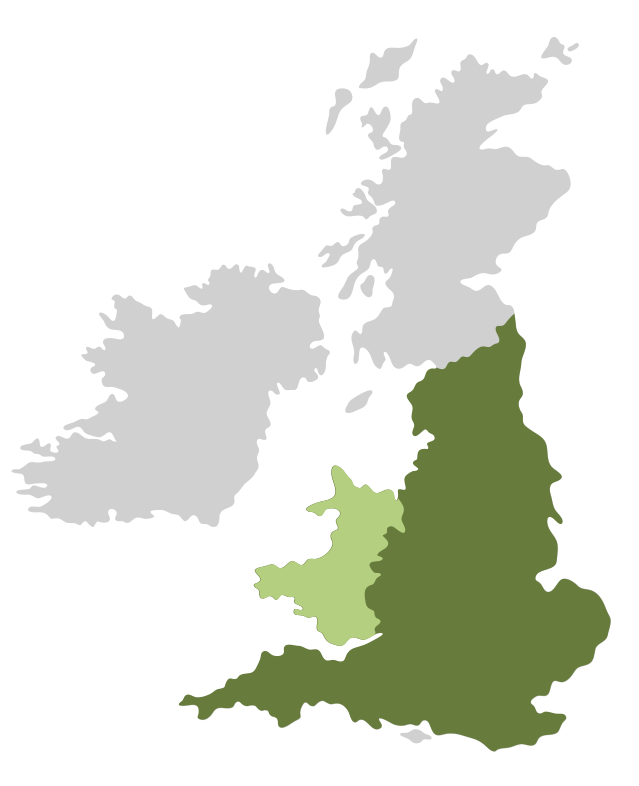
Whatever your situation, we can help you gain access to some of the very best conveyancing solicitors across England and Wales. Here’s how property solicitors can help you:
How does online conveyancing work with Homeward Legal?
Whether you are buying or selling, remortgaging or looking to transfer equity from your property, you can feel confident that with Homeward Legal you will be working with the best conveyancing professionals.
If you’re looking for help, it’s easy to get an online conveyancing quote in a matter of minutes, or you can call us on . We always offer fixed legal fee** conveyancing, so there are no hidden extras or unexpected costs for you to worry about. The price you are quoted will be the price you pay.
We have access to a panel of conveyancing specialists across England and Wales, all of whom can make your next move run as smoothly as possible. Whether you’re buying, selling, remortgaging or looking to complete a transfer of equity, we’re here to take all the stress out of property conveyancing.
Should you wish to proceed with us, we’ll put you in touch with a member from our panel of specialists across England and Wales. Wherever you are, rest assured that we’ll be able to find a fully qualified property solicitor.
As appointed members of the UK’s leading lender panels, your conveyancing solicitor will manage the legalities of your individual property and lender needs. They’ll take care of all the paperwork so you don’t have to worry.
What’s more, our team are available six days a week, so we’ll be on hand to answer any queries you may have about the conveyancing process.
How much do conveyancing solicitors cost?
The fees you pay to your conveyancing solicitor will vary depending on the value of the property, so there isn’t a simple answer to this question. However, you can always rely on us to be transparent. We’re firm believers in providing fixed legal fee** conveyancing. The price you are quoted when you come to us will be the price you pay.
Some online conveyancing quotes may not include all the charges that you will have to pay, which is why they may seem cheaper at first. But we’ll be upfront in including and explaining all the fees so you have a clear idea of what to expect right from the start.
That’s why we’ve provided all the information you might need right here, including details of the costs involved, how to get an online conveyancing quote and why you can rely on Homeward Legal to put you in touch with the best conveyancing solicitors in England and Wales.
Should you wish to know more about the costs involved in property conveyancing, we’ve provided further, in-depth information on the average conveyancing fees in 2024.
Why choose us
As you can see from our hundreds of positive Trustpilot reviews, we have established a superb reputation among our customers. Here are just some of the reasons why:

Fixed Legal Fee Conveyancing**
With Homeward Legal, there will be no hidden costs. The price we quote is the price you will pay.

No-Completion No Fee†
If your move falls through for any reason you won't pay any fixed legal fees**.

Simple &
Straightforward
We pride ourselves on not confusing you with lots of legal jargon - just plain, simple English.

Trusted
Customer service is something we pride ourselves on. But don't take our word for it - read our glowing Trustpilot reviews.

Convenient Conveyancing
We work with a panel of conveyancing solicitors across England and Wales, so the conveyancing solicitors near you will have local knowledge.

Regulated
Our conveyancing specialists are all regulated by the Solicitors Regulation Authority or the Council for Licensed Conveyancers.
Get in touch about residential conveyancing solicitors today
If you’re looking to buy, sell, remortgage or complete a transfer of equity, you’ll need a fully qualified conveyancing solicitor to take care of the paperwork, and that’s where Homeward Legal can help you.
We’ll put you in touch with one of our specialist panel housing solicitors across England and Wales. All you have to do to get started is enter a few details and you’ll have an online conveyancing quote in a matter of minutes. Or, if you prefer, you can give us a ring on or request a callback and a member of our expert, friendly team will be happy to speak to you.
Frequently asked questions about property conveyancing
The conveyancing process can seem daunting and complicated, and we understand that you might have plenty of questions. Below, we feature some queries that are commonly asked by home-movers.
Any extra costs need to be fair and only come into force where your conveyancing lawyer has to perform these additional tasks for you and provided they could not be anticipated at the start of the process.
In these instances, Homeward Legal includes all foreseeable legal costs in their standard conveyancing offering as part of the fixed legal fee** plus we offer No-Completion No Fee Protection† so that in the unfortunate event that your property transaction falls-through you will not be liable for any of the conveyancer's fixed legal fees for the work completed.
Get an online conveyancing quote today or call our friendly team who are available 6 days a week on .The local authority search is a set of enquiries made of the local authority's records by your conveyancing solicitor. These relate specifically to the planning and building control records, roads and highways, local development plans and other aspects of local authority control that might impact your property in some way. It is worth noting, however, that the search only relates to the property you are thinking of buying, and will not report on any records affecting neighbouring or nearby properties.
The local authority search focuses on the subject property only, so, as an example, it would not reveal planning applications relating to other properties or land in the area around your prospective building. A separate search, known as a 'Plan’ or ‘Planning Search', would be needed to extend the search to include neighbouring properties and any adjoining land.
The local authority search is a key part of the conveyancing protocol because the information is generally highly relevant to the purchaser’s interests. Mortgage lenders will also insist on this search being carried out, unfortunately at the expense of the buyer (although Homeward Legal can act on the behalf of most lenders and advisers so that they do not pass on their legal costs to you).
However, if you are a cash-buyer, it is up to you whether you choose to have this search carried out, and you should inform your conveyancing solicitor if this is the case at the time of appointing them.
Want to see how this looks on one of our quotes? Try our online calculator, or call us now on .SDLT stands for Stamp Duty Land Tax, and is a tax payable to Her Majesty’s Revenue and Customs (HMRC) by a buyer on all properties bought for £125,000 and above.
However, in July 2020, Chancellor Rishi Sunak announced a stamp duty holiday, which means that anyone completing on a main residence up to the value of £500,000 will not have to pay any stamp duty. This was extended in the 2021 budget to the end of June , and from June to September 2021 was extended to property's up to the value of £250,000. Please note that this only applies to properties in England and Northern Ireland.
There are other government schemes in place such as ‘Help to Buy’ which you may be eligible for. In particular, for first-time buyers, the stamp duty threshold has been raised to £300,000. For more information our experienced team are on hand.
The information provided below is how SDLT was calculated prior to Chancellor Sunak’s announcement.
Note that if the property being purchased is a buy-to-let or a second home, then, as of April 2016, each value band has been increased by 3%.
First-time buyers already have a higher stamp duty threshold, paying no property tax on transactions up to £300,000.
The current levels of SDLT have been in place since December 2014 and are calculated as a percentage of the final purchase price according to the following brackets:
- £0 - £125,000 - 0% (3% for buy-to-let, or second homes)
- £125,001 - £250,000 - 2% (5%)
- £250,001 - £925,000 - 5% (8%)
- £925,001 - £1.5 million - 10% (13%)
- £1.5 million - 12% (15%)
The tax owed is not a flat rate but is calculated as the purchase price moves up through the bands. So, for example, if you buy a house for £950,000, the first £125,000 will not incur any tax, the next £125,000 will be taxed at 2%, the next £675,000 at 5% and the remaining £25,000 at 10%:
First £125,000 = £0
Next £125,000 = £2,500
Next £675,000 = £33,750
Final £25,000 = £2,500
Total = £38,750
Your conveyancing solicitor will submit the SDLT return to HMRC on your behalf upon completion of your home purchase, at the same time as registering the change of ownership with the Land Registry.
Note, too, that, from 1 April 2018, the Welsh government abandoned SDLT and introduced the Land Transaction Tax (LTT), which operates on a very similar basis, although the trigger threshold is currently set at £180,000.
Your conveyancing solicitor should be able to advise if there are any other government schemes in place (such as ‘Help to Buy’) to assist with your purchase and whether you are eligible to take advantage of any that are running. In particular, for first-time buyers, the stamp duty threshold has been raised to £300,000.
If you are looking for ways of cutting costs, there is no better way of doing it than choosing one of the best conveyancing solicitors in the country with Homeward Legal. Get an online calculator, or call us now on , so we can match you with the best conveyancing solicitor based on your conveyancing needs.Whether you are buying or selling, the earlier you can appoint your conveyancing solicitor, the better, because the legal work can start very early in the process. For sellers, this means that your solicitor could draft a contract in advance of finding a buyer, and for buyers, conveyancing solicitors can verify ID checks, proof of funds and the mortgage application if needed.
Promptly instructing a solicitor can reduce any chance of the other side pulling out, and will also mean that you are ready to push forward with an offer as soon as you find a property that you want to buy.
With Homeward Legal's No–Completion No Fee† promise that in the unfortunate event that your property transaction falls-through you will not be liable for any of the conveyancer's fixed legal fees for the work completed.
Plus, when you get a quote for conveyancing services from us, we offer a Fixed legal fee** conveyancing quote with no hidden costs
Why not complete an instant online Fixed Legal Fee* Quote with No - Completion No Fee† today. Or, call one of our friendly team, available 6 days a week, on .It is strongly recommended that all prospective purchasers book an inspection of the property they are intending to buy. There is a wide range of defects that can affect a property, from cracked roof tiles to the suspected existence of asbestos, from unsupported chimney stacks to wet rot in the cellar. These will not be reported on by a conveyancing solicitor, as it is not part of the legal remit.
In addition, a survey will identify any structural issues so that you can budget for remedial and upkeep works if necessary. Local builders and your RCIS surveyor can provide detailed advice on what you should consider, and whether it is worth renegotiating the asking price to help pay for any major works post-purchase.
New owners will often be frustrated with the lack of formality around what fixtures and fittings should be included in a sale, and indeed what should be included under each term. Sometimes this list isn't firmed up until the transaction nears completion, and it can also form post-offer negotiations, causing potential delays.
However, to avoid confusion, an approximate list will need to be agreed by the buyer and seller prior to offer. The seller will note these in the formal conveyancing form known as the fixtures and fittings form (FFF), which confirms in detail what will be sold with the property, and which formally becomes part of the contract of sale.
Your conveyancing solicitor will, in the first instance, talk you through the process and what’s expected of you including the filling in of various forms. Give us a call on , so we can match you with the best conveyancing solicitor based on your conveyancing needs.Conveyancing searches are a common bundle of queries carried out for the buyer, with respect to the specific property they are purchasing. The most common (and mandatory for taking out a mortgage) searches are Local Authority, Drainage and Water, Chancel Liability and Environmental, although circumstances may dictate that further searches (e.g. Brine, or Coal or Tin-Mining) may be required, particularly if you are financing the purchase with a mortgage. In these circumstances, your conveyancing solicitor will advise and discuss the need to order these additional searches, as well as providing the cost of these disbursements.
Buyers should be aware that searches cover solely legal-related matters. If you want to know about the structural integrity of the property, you are strongly advised to commission a survey with an RCIS chartered surveyor.
Many contaminants can impact a residential property. These need not be restricted to chemical or mineral pollutants either, since investigations into contamination also include proposed erection of mobile masts, or the proximity of electricity pylons.
Where the property has been built on former industrial or agricultural land, consideration will be given to any known pollution that exists in the topsoil or in the vicinity. All aspects of the environmental impact to the property will be considered as part of the environmental searches and reported in the conveyancer’s report on title for the property.
No. With Homeward Legal's panel of conveyancing solicitors, when you get a quote for conveyancing services from us, the legal price we quote you is the price you'll pay.
You should be aware, however, that some property solicitors do not give accurate quotes, only estimates, often putting standard conveyancing fees in the small print, possibly to make the headline offer seem far more attractive. The final bill you receive may then be much more than you budgeted for as a result. With Homeward Legal, we offer Fixed Legal Fee** conveyancing quote with no hidden charges and with our No-Completion No Fee†.
If in the unfortunate event that your property transaction falls-through you will not be liable for any of the conveyancer's fixed legal fees* for the work completed.
Why not complete an instant online Fixed Legal Fee* Quote with No - Completion No Fee† today. Or, call one of our friendly team, available 6 days a week, on or by using our eligibility checker.When acting for a purchaser, a conveyancing lawyer will carry out an environmental search, which will identify if the property is on a known floodplain.
Whether the house or flat is in one of these locations or not doesn't necessarily mean that it has flooded in the past, or will be flooded in the future, because the basic environmental search only assesses the general risk. Furthermore, the information returned in the search cannot factor in the existence and effectiveness of flood defences, such as the Thames Barrier.
If a potential risk is identified and is deemed significant, your conveyancing lawyer may recommend a further, more detailed search (from a specialist company such as Searches UK or Landmark), which will be charged as a third-party fee. Please speak to your solicitor if you have any concerns about the flood risk with respect to your property.
See a sample Homecheck Flood Report.
Now’s the time to get your move moving with the best conveyancing solicitors from Homeward Legal. Complete an instant online quote tool for your fixed legal fee* conveyancing quote, safeguarded by our No-Completion No Fee†, or, if you want to talk to one of our friendly, expert team, call us on or by using our eligibility checker.